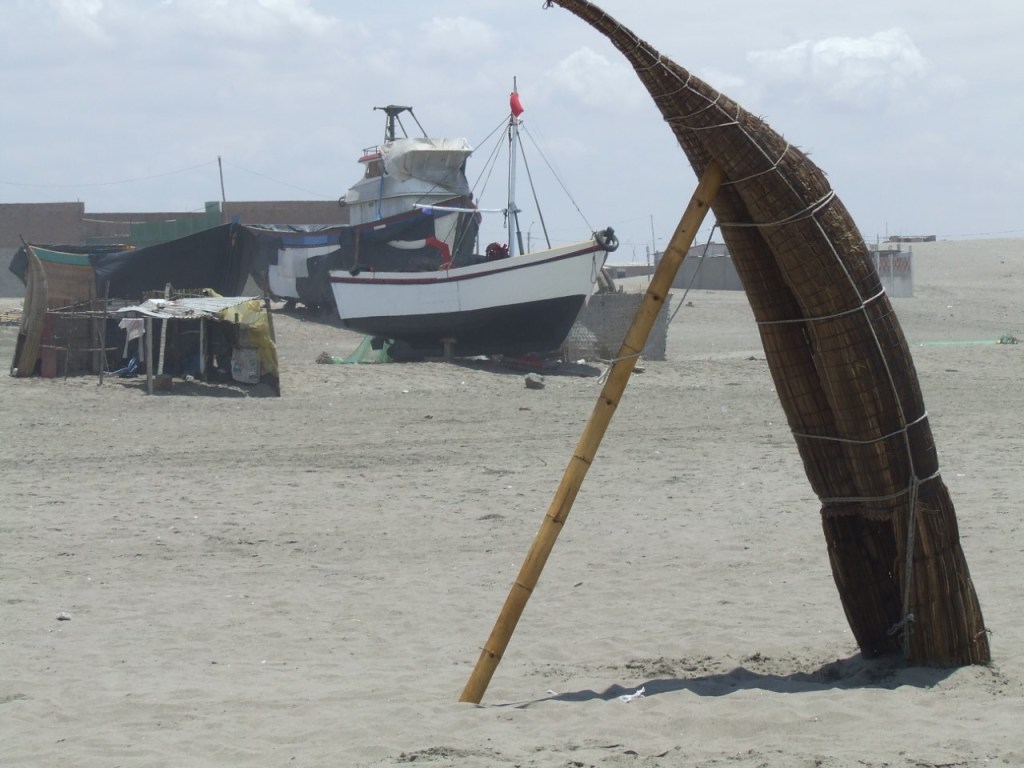
It’s 2008, and I’m sitting in a place that I will probably never sit again. I have my back to the small but bustling seaside village of Santa Rosa, Peru facing the rolling waves of the Pacific Ocean. To my left there are rows of straw kayaks with an abrupt, flat stern, planted into the sand, leaning on bamboo sticks. To my right, I see more modern but still modest commercial fishing boats with men working vigorously on the decks towards their next trip to the ocean. Children play soccer along the beach in a classic South American scene. Behind me are the noises of the Saturday crowd walking through their town towards the market where they are serving fresh ceviche, made of fish from the morning’s catch and marinated for an hour or two in the particularly acidic lime grown at this latitude. I have stepped into another universe, even for someone that has lived for the last year in Lima, Peru’s capital city.
I ventured here from Lima to see the Museum of The Royal Tombs of Sipan in Lambayeque. An impressive and modern museum built just five years previously featuring the pre-Incan treasure found in the 80s in newly dug up royal tombs. Travelling by bus along the Pan American highway, I rode eleven hours through the largely unvaried desert from Lima north along the coast to Chiclayo, Peru’s fourth largest city. The landscape on the journey is a vast expanse of sand, dotted with crumbling brick walls displaying political slogans and pleas for a cleaner Peru without littering. I saw just the occasional modest one-room adobe home with no windows surrounded by serious-looking, barefooted children. Chiclayo, Peru’s fourth largest city, is a almost a surprise encounter after the long ride through the empty desert. I admit, I jumped onto a small bus to nearby Lambayeque within a half hour of arriving.
After checking out the polished new museum (which was fantastic and I highly recommend!), the ocean was calling me and I read that Santa Rosa was the nearby place for the best ceviche, an ongoing search that was pastime of mine during my years in Peru. Approaching the town by even smaller bus, I saw a massive construction project in the works. Enormous fishing boats, towering above the ones I’d see later at the beach, at the stage of no more that a wooden frame, were being built from scratch in the middle of the desert with nothing else in sight. This major infrastructure project was almost alarming to observe amongst the empty desert.
Santa Rosa had been planned in a most convenient manner. The main market was right on the beach, and one could eat what was boasted as Peru’s best seafood emersed right in the most vibrant area of town, but also among the crashing waves and the fishing boats that had just hauled in the meal. The sternless kayaks planted in the sand here, I discovered later, are called caballitos (little horses). Fishermen ride alone through the waves on these boats made of reeds, known as the world’s first surf boards and in use for 3000 years. Considering the new mega ships I had just seen in construction, and the few bigger boats also now appearing on the beach to contrast the caballitos, it struck me that this traditional and likely very sustainable fishing method that had been in place for generations may be in the process of replacement.
It would be after this adventure of living in Peru that I would work for three years with one of Canada’s leading sustainable seafood eco-logos, Ocean Wise. In fine dining establishments, seafood stores and within seafood distribution companies, the Ocean Wise logo signals to buyers that seafood came from a less damaging source that promotes long term health of the eco-system. Several programs (such as Ocean Wise) are based on the science and standards produced by the Monterrey Bay Aquarium Seafood Watch Program. In general, these standards examine wild fisheries for four components to determine how they are rated for sustainability: if the stock is overfished, if other species are caught by mistake in large volumes (bycatch), if habitat is damaged in the fishery (usually from the fishing gear used and how invasive it is), and if the fishery is well managed in order to continue this balance over time, and reduce illegal fishing.
In tourism, sustainable seafood logos have helped to give chefs, seafood suppliers, and event organizers confidence that they are sourcing from a healthy fishery that does little harm to the fish stocks and surrounding ecosystem. A recent example in 2025 of tourism applying sustainable seafood certifications is Novotel, who announced they would only source Marine Stewardship Council (MSC) Certified wild caught fish among other sustainable seafood initiatives. MSC is a certification that evaluates and certifies specific fisheries against standards similar to the Seafood Watch Program, and also provides a chain of custody to confirm throughout the supply chain that the fish served in a restaurant did in fact come from the certified fishery.
One can imagine that fishing while surfing on a little kayak made of reeds would not result in overfishing or significant bycatch, and likely contributed to keeping the fish stocks off this coast in a lovely natural balance with the surrounding eco-system for years. The ceviche served at the market, steps from where the catch is dragged in that same morning, is only available fresh if the fish was in abundance that day. Remembering the frames of the massive boats being built in the desert that day now alerts me to a traditional practice likely being replaced with something bigger. Something bigger that likely uses more invasive fishing gear, has the ability to take too many fish, and could result in significant bycatch or damage to the surrounding habitat. In other words, moving towards a system off balance.
Again, this was back in 2008. I hope someday I can see Santa Rosa and the North Coast of Peru again and experience how that big beautiful museum built in Lambayeque with those enormous new boats that were rising up in the adjacent desert might have altered the fabric of life there. And to see if the traditional knowledge of a uniquely shaped, flat-sterned surfing-fishing kayak that had kept nature in balance for thousands of years was still in use, and that beachside ceviche market still thriving.
 Poirier Impact Solutions
Leave a comment